
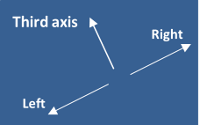
Third axis thinking
Guiding principles for achieving successful outcomes
Mark Henderson, former Science Editor of “The Times” wrote:
“Politics has a third axis too. It measures rationalism, scepticism and scientific thinking – the willingness to base opinions on evidence and to keep them under review as better evidence comes along.”(The Geek Manifesto – Why Science Matters., Bantam Press, 2012)
Here we use the concept of a ‘third axis’ to represent the use of a set of guiding principles that go beyond, but include politics and go beyond, but include scientific thinking. The principles are used where people seek to achieve successful outcomes in complex situations. Some applications are briefly described and the potential for use in politics is reviewed.
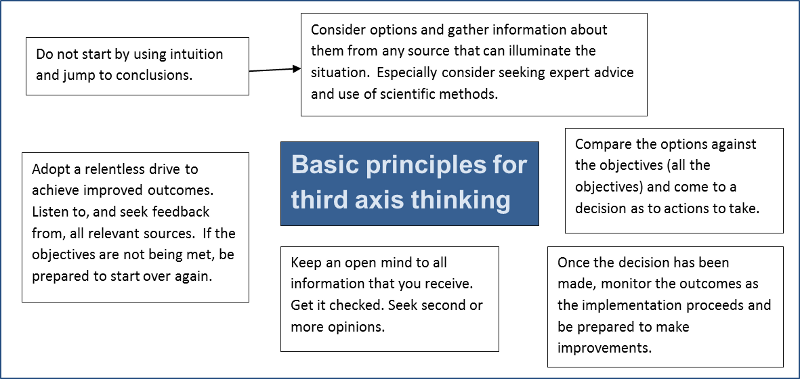
Basic principles in third axis thinking are shown below:
Third axis thinking in professional engineering
Use of third axis principles is pervasive in professional engineering practice. For example the design process, that is closely related to the principles listed above, is a standard technique in engineering design.
Manufacturing is highly competitive globally and UK firms who operate in such markets need to work very hard to keep costs down and quality up. Third axis thinking is an essential feature of their operations. The major improvements made in Japanese manufacturing in the 20th century were significantly influenced by third axis thinking, introduced to them by an American - W E Deming One of Deming’s main guiding principles was that to improve production one must have a constant drive to improve the process.
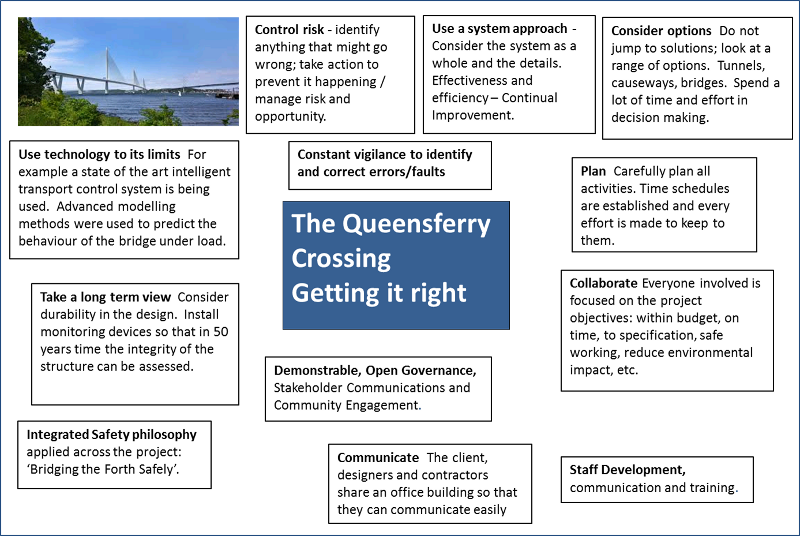
Third axis thinking has led to developments in how infrastructure projects are managed. For example, shown below is a collection of principles used in the design and construction of the Queensferry Crossing over the River Forth, presently under construction (2015). The wide range of principles shown illustrates the complexity involved in in the drive for success in such large projects. As an example of good thinking ,the integrated safety philosophy requires that everyone involved in the contract is thinking and acting to reduce construction risk.The incidence of safety lapses is kept at a low level and the main target of avoiding any fatality is likely to be achieved.
For more information about third axis thinking in engineering see here.
Other contexts where third axis thinking is used
The third axis approach is the basis of the scientific method. It is inherent in criminal justice where no judgment is made until all sources of evidence have been exhausted and where the appeals system infers acceptance that evidence can be missed and judgments can be unreliable. It is also fundamental to mainstream medical research, testing and validation of treatments and drugs. It seems likely that any enterprise that achieves good outcomes in situations of complex uncertainty uses third axis thinking.
Use of third axis thinking in politics
A third axis approach for a politician in reaching and implementing a decision on a policy matter would be:- At the outset the use of intuition is put to the side. It may be needed later. One is open to all ideas. Both left and right strategies can be considered.
- Advice is widely sought especially from experts but all information is treated with caution: experts are not always right; non-experts are often wrong.
- Solution options are generated and information about them is gathered using all techniques that can be useful in the context. In particular scientific methods such as predictive modelling and statistical analysis are used to provide numerical information.
- The efficacy of the options is then compared against a set of criteria that address all relevant issues.
- Decision time approaches but while options are still open, seeking the views of the public represents good governance. The information, or at least summaries of it, that is used to assess the options should be made available to the public.
- It may be that the collected information does not lead to a clear choice of option in which case judgement is needed. But the judgement should be very strongly guided by the evidence.
- The decisions are made and implementation proceeds. Despite the careful process to get the policy right, it may not work in practice as well as expected. The outcomes should be constantly monitored. Feedback should be sought (but treated with caution). If necessary, tweaks or major changes should be made.
The use of third axis thinking is not absent in Government activity. For example, the client team for the Queensferry Crossing project, discussed above, is led, very successfully, by the Major Projects Division of Transport Scotland, a Department of the Scottish Government.
For a number of years IESIS has promoted the principle that, in effect, third axis thinking needs to be applied to the development of energy policy - see http://www.iesisenergy.org/
Wider use of third axis thinking would significantly reduce the risk of unsatisfactory policy outcomes. This would be of advantage to all, and especially to politicians.